
Designing Drying Systems for Flexibility in a Changing Product Portfolio
A drying system may perform exactly as expected when it is commissioned—and still become a constraint a few years later.
Product portfolios change. New formulations enter production. Customer specifications evolve. Seasonal ingredients create different processing demands. Production volumes shift. A material that was once a secondary stream can become a significant opportunity.
That makes flexibility an important consideration when investing in industrial drying equipment.
The goal isn't to design a system for every product you might ever run. It's to avoid locking today's assumptions into tomorrow's equipment.
Flexibility Means More Than Capacity
When evaluating an industrial drying system, flexibility is often reduced to a simple question: Can the system handle more volume?
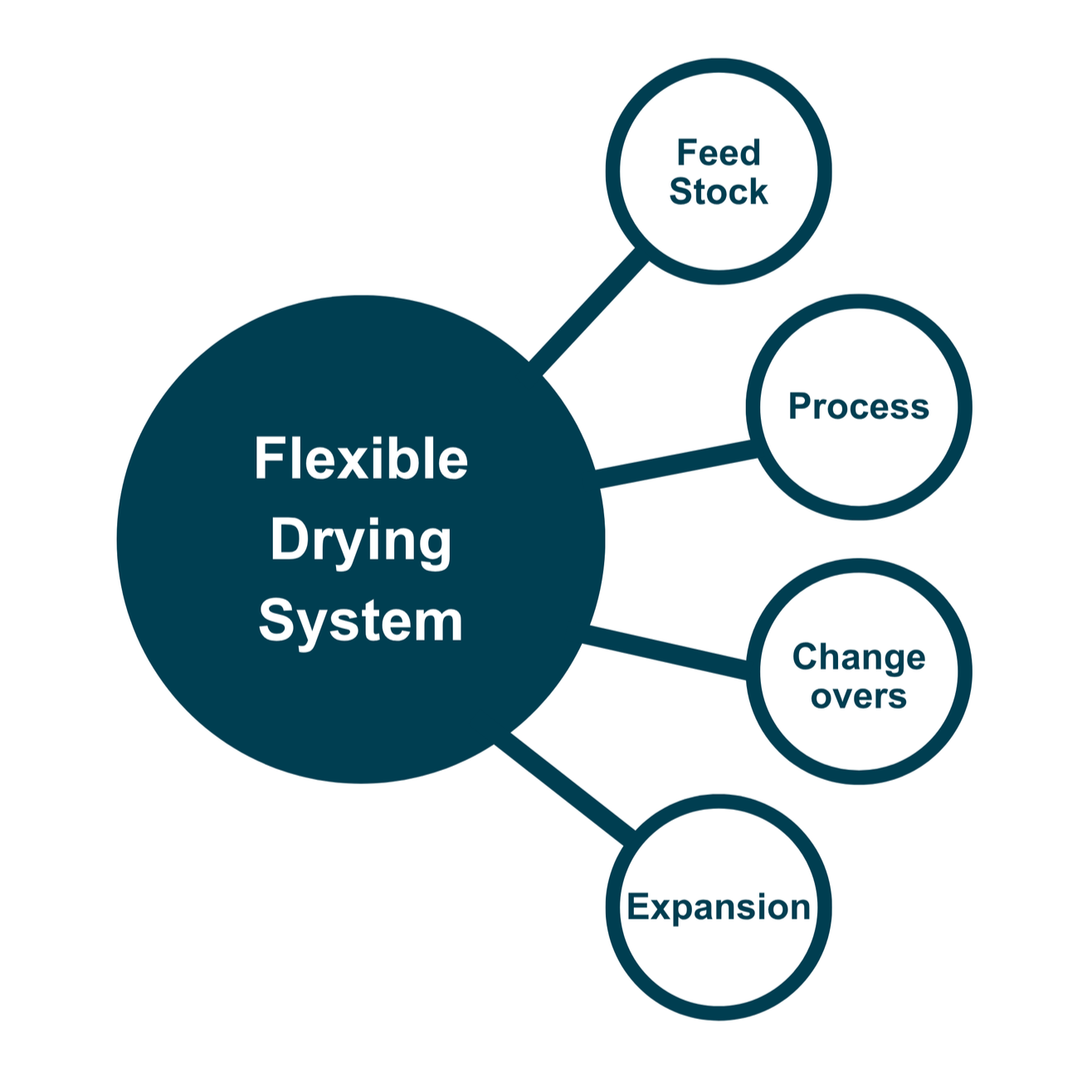
Capacity matters, but it is only one dimension of flexibility. A system designed for a changing product portfolio may need to accommodate differences in:
Feed moisture and rate
Particle size and physical characteristics
Bulk density
Final moisture requirements
Product specifications
Processing conditions
Cleaning and changeover requirements
Two products can have similar throughput requirements but behave very differently during drying. A system designed around a narrow operating point may perform well for one product but become difficult to optimize as feed characteristics or specifications change.
A flexible drying system instead provides an appropriate range of controllable operating conditions, giving operators more room to optimize processing for different materials.
Design Around a Range of Process Conditions
Technical flexibility comes down, in part, to the system's process window—the range of conditions within which it can operate effectively.
Variables such as feed rate, moisture content, temperature, airflow, residence time, particle characteristics, and mechanical energy can influence drying performance and final product quality.
For multi-product operations, the ability to adjust these variables can be just as important as throughput.
The question isn't simply whether a system can process different materials. It's whether those materials can be processed appropriately and consistently without forcing every product into the same operating conditions.
This is one reason adaptable drying systems can provide greater long-term value than equipment optimized around a single operating point.
Modular Design Creates Options
Modular design can also support flexibility—but modularity itself isn't the objective.
The important question is: Where does modularity create useful options?
A well-designed system can separate major functions or provide configurable components that allow equipment to adapt as requirements change. Depending on the application, this can create opportunities to:
Adjust processing capacity
Accommodate different feed characteristics
Add capabilities as requirements develop
Support additional products without replacing the entire system
Expand processing capability in stages
The value of modular architecture is therefore less about simply making equipment "bigger later." It's about avoiding a rigid configuration based entirely on today's production requirements.
Changeovers Are Part of Flexibility
A system may technically be capable of processing multiple products and still be difficult to operate as a multi-product system.
Changeovers can require cleaning, adjustments, material purge, verification, and downtime. For some applications, residual material or cross-contamination concerns can make the transition particularly significant.
That's why dryer changeover time should be considered when evaluating equipment. Time, labor, cleaning requirements, material loss, and production downtime all affect the practical flexibility of a system.
The ability to process multiple products has limited value if switching between them is inefficient.
Future-Proofing Without Overbuilding
Future-ready equipment does not mean buying the largest or most capable system available.
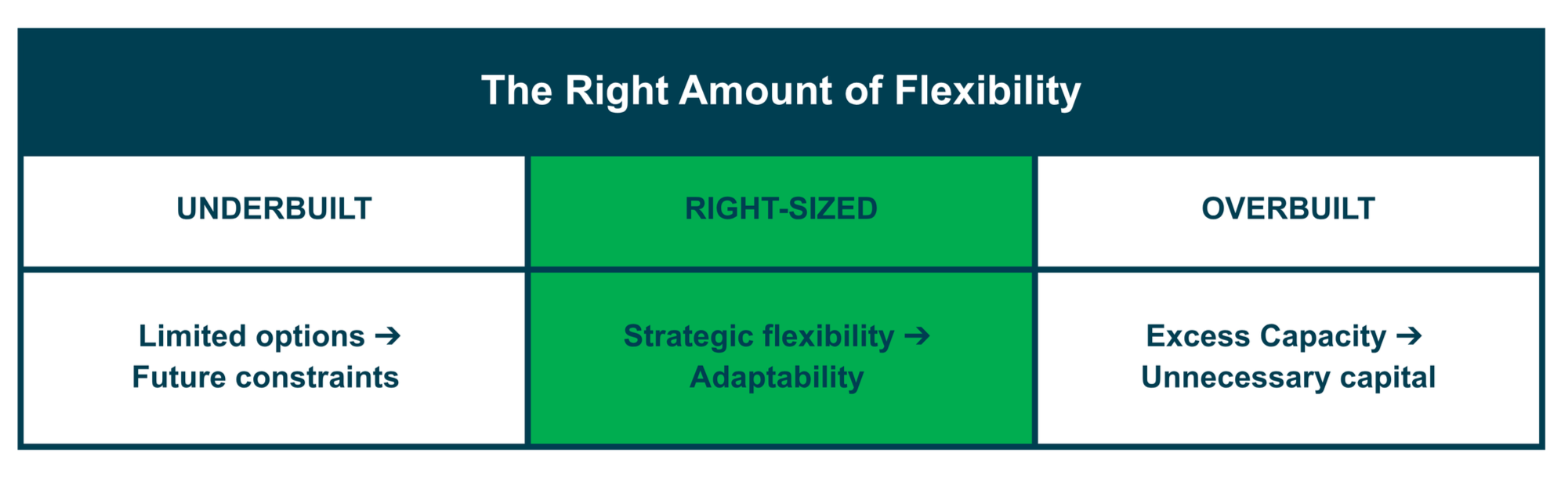
Overbuilding ties up capital in capacity or capabilities that may never be used. Underbuilding can create the opposite problem: a system that becomes a constraint as the business changes.
The goal is right-sized flexibility.
Before making an industrial drying equipment investment, consider:
What are we processing today?
Understand current feedstocks, volumes, specifications, and operating conditions.
How could our product mix change?
Consider realistic new products, seasonal materials, customer requirements, and potential new revenue streams.
Which process variables will need to change?
Determine whether future materials will require different moisture targets, feed rates, temperatures, residence times, or other operating conditions.
What level of changeover flexibility will we need?
Quantify cleaning, labor, downtime, and material-loss requirements.
Which capabilities need to be built in now?
Distinguish between flexibility that is strategically valuable today and capabilities that could reasonably be added later.
This approach helps manufacturers avoid paying for every possible future scenario while still protecting the value of today's capital investment.
For manufacturers considering changes to their drying operation, capacity planning is only one part of the decision. Modernizing drying capacity without shutting down production can address today's operational requirements—but future product flexibility should also factor into the capital decision.
A Practical Framework for Evaluating Drying System Flexibility
When comparing industrial drying technology, look beyond throughput, footprint, energy consumption, and installed cost.
Evaluate flexibility across four areas:
1. Feedstock Flexibility: What could we process?
Can the system accommodate the range of moisture levels, particle characteristics, densities, and other physical properties you expect? GTF's material evaluation process can help determine moisture, particle characteristics, flow behavior, bulk density, and RENU™ compatibility before a sample run.
2. Process Flexibility: How much can conditions vary?
Can operating conditions be adjusted to achieve different product specifications while maintaining consistent performance?
3. Changeover Flexibility: How efficiently can we switch?
How much time, labor, cleaning, and material loss are required when switching products?
4. Expansion Flexibility: What happens when we grow?
Can the system accommodate reasonable changes in production requirements without requiring a completely new equipment investment?
Together, these factors provide a more complete picture of long-term equipment value.
Invest in Options, Not Excess
A changing product portfolio doesn't necessarily call for more equipment. It calls for equipment that can adapt.
The objective of a flexible drying system isn't to prepare for every possible future. It's to build enough technical range and architectural flexibility into today's investment that tomorrow's changes don't automatically require starting over.
For manufacturers evaluating industrial drying equipment, the right question isn't only: "What does our process need today?"
It's also: "How much flexibility will we need when our process changes?"
A drying system designed around that question can provide something more valuable than excess capacity: options.
Not sure how much flexibility your process requires?
Let's evaluate your materials and processing requirements to determine whether RENU™ is a fit for your application: info@gtf-technologies.com.